Entering the German Automotive Market: A Foreign Supplier's Guide
Foreign suppliers entering the German automotive market: OEMs, tier-1 landscape, EV transition, IATF certification, and where the real opportunity lives.
Contentstap to expand
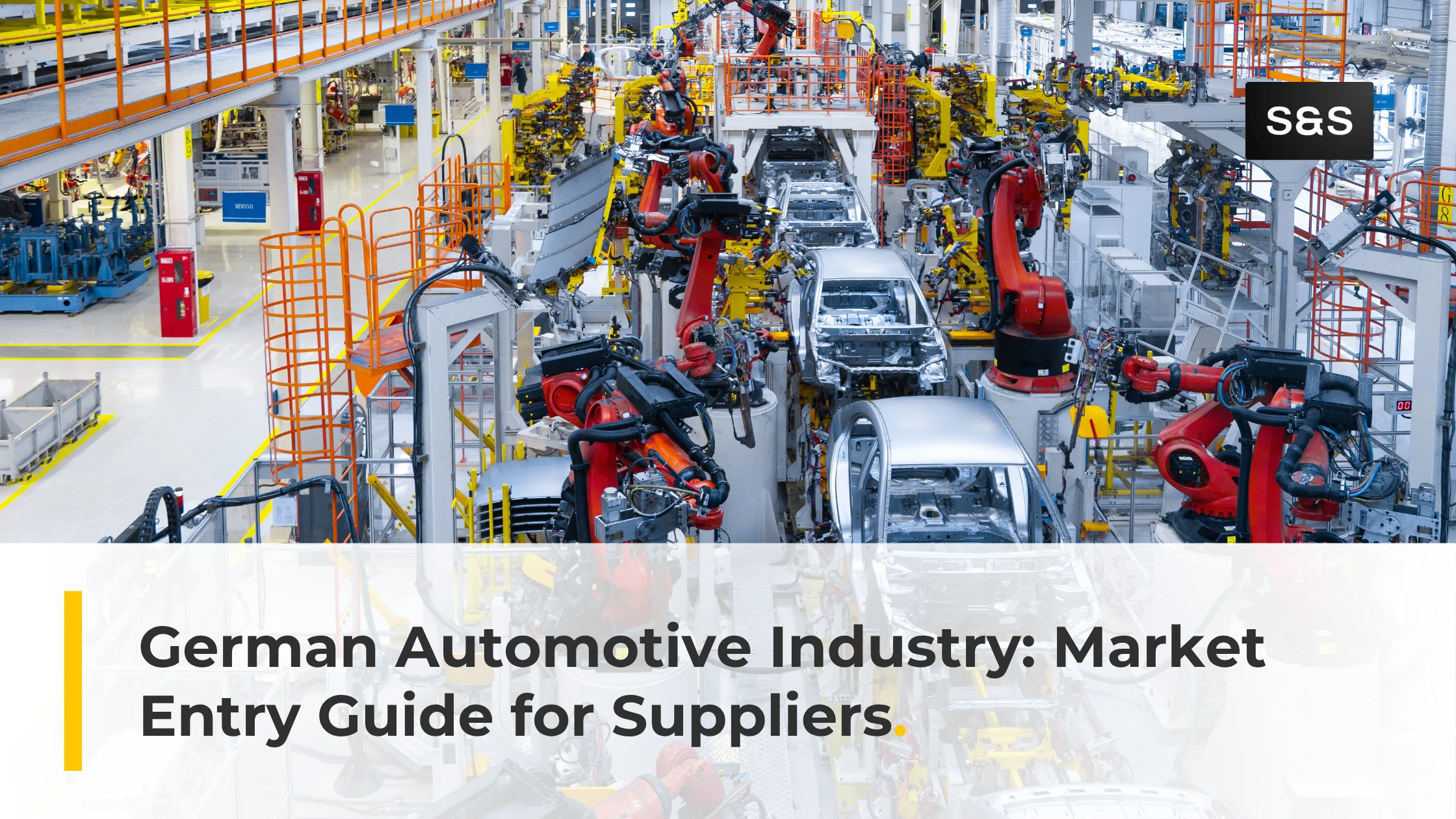
Short answer: The German automotive market is one of Germany's largest industries and a strong opportunity for foreign suppliers in specific layers, particularly software, EV-transition components, battery systems, charging infrastructure, and tier-2/tier-3 supply for niche components. At the OEM level (VW, BMW, Mercedes, Stellantis-Opel, Ford Germany), the industry is in active structural transition: plant closures, electrification cost pressure, Chinese EV competition. At the supplier level, the standard quality-management gate is IATF 16949 certification, typically 12-18 months to obtain, with VDA 6.3 process audits adding a further qualification layer. Supplier qualification cycles with OEMs run 12-24 months minimum. Foreign founders typically have stronger entry routes via software (which sells on enterprise-B2B-SaaS cycles, not multi-year qualification), via M&A acquisition of established German suppliers, and via specific EV-transition components where incumbent ICE suppliers are struggling to retool.
The structural picture: where the German automotive market actually is
The German automotive industry is going through the largest structural transition in its post-war history. Foreign founders looking at the sector benefit from honest framing rather than press releases.
At the OEM level, the news is mixed. Volkswagen announced major restructuring in 2024-2025 including plant closures and significant job cuts as the group repositions for the EV transition and faces eroding market share in China. Stellantis (which owns Opel) is restructuring its German operations. Mercedes-Benz and BMW continue to perform better than VW but face share losses in the premium EV segment, particularly in China where domestic brands have moved rapidly. The traditional German automotive export model is under pressure.
At the tier-1 supplier level, consolidation and restructuring are widespread. Bosch (still Germany's largest automotive supplier) continues to invest in software and electrification. Continental has restructured. Hella has merged with French Faurecia to form FORVIA. ZF Friedrichshafen is restructuring. Schaeffler and INA-Schaeffler are integrating. Several other tier-1 names face the same EV-transition cost pressure.
At the tier-2 and tier-3 Mittelstand supplier level, hundreds of family-owned suppliers face two simultaneous pressures: EV transition (the parts they make for internal-combustion engines won't be made for EVs at the same volume) and generational succession (many were founded in the 1950s-1980s and the founding-family successor question is increasingly active). This creates both stress and opportunity: stress because many suppliers are reducing or pivoting; opportunity because acquisitions at favourable valuations have become more available than in previous decades.
At the software layer, the picture is the most positive. German OEMs are accelerating software investment, often through external partnerships rather than fully in-house development. Software-defined vehicle, ADAS, in-vehicle infotainment, OTA updates, manufacturing analytics, predictive maintenance: all active buying segments where German OEMs are explicitly looking for foreign and non-traditional suppliers.
At the new-entrant level, Tesla operates the Gigafactory Berlin-Brandenburg, Chinese EV brands (BYD, NIO, MG, Xpeng, Geely's Polestar and Volvo Cars subsidiaries) are entering German retail and increasingly considering European manufacturing, and several European startups (Rimac, Lucid, Aiways) maintain German R&D or sales presence. The supplier base for these entrants is partly different from the traditional German automotive base.
The German automotive OEMs and tier-1 suppliers
A current map of who matters.
German OEMs
- Volkswagen Group. Headquarters in Wolfsburg (Niedersachsen). Brands: VW, Audi (Ingolstadt), Porsche (Stuttgart), Bentley, Lamborghini, Bugatti, Ducati, MAN Truck (Munich), Scania (Sweden but VW-owned). Europe's largest auto group by volume.
- BMW Group. Headquarters in Munich (Bayern). Brands: BMW, Mini, Rolls-Royce. Strong premium and EV positioning. Plant Munich, Plant Leipzig (electric), Plant Dingolfing.
- Mercedes-Benz Group. Headquarters in Stuttgart (Baden-Württemberg). Brands: Mercedes-Benz, Mercedes-AMG, Maybach. Plant Sindelfingen, Plant Bremen, Plant Berlin (electric), plus international plants.
- Stellantis Germany. Through the Opel brand. Headquarters in Rüsselsheim (Hessen). Plants in Eisenach (Thüringen), Kaiserslautern (Rheinland-Pfalz). Restructuring active.
- Ford Germany. Headquarters in Köln (NRW). Plant Köln, Plant Saarlouis (Saarland; restructuring). German operations of US-headquartered Ford Motor Company.
Major German tier-1 suppliers
- Robert Bosch GmbH (Stuttgart, Baden-Württemberg). Germany's largest automotive supplier by far. Diversified beyond automotive.
- Continental AG (Hannover, Niedersachsen). Tires, drivetrain, ADAS, automotive electronics.
- ZF Friedrichshafen (Friedrichshafen, Baden-Württemberg). Transmissions, drivetrain, e-mobility. Major TRW acquisition history.
- Mahle GmbH (Stuttgart, Baden-Württemberg). Engine components, thermal management.
- Schaeffler AG (Herzogenaurach, Bayern). Bearings, drivetrain, transmissions. Integration with INA.
- FORVIA (merger of Hella, German, and Faurecia, French). Lighting, electronics, body modules.
- Thyssenkrupp Automotive (Essen, NRW). Steering, body, drivetrain.
- Brose (Coburg, Bayern). Mechatronic systems, seating, doors.
- Webasto (Stockdorf near Munich, Bayern). Roof systems, EV batteries (Battery business).
- Hirschvogel (Denklingen, Bayern). Forging, drivetrain components.
The tier-2 and tier-3 supplier base is much larger: thousands of Mittelstand companies, mostly family-owned, with deep specialisation in specific components, materials, or processes.
Geographic clusters
| Region | Main OEM presence | Supplier density | Cluster character |
|---|---|---|---|
| Baden-Württemberg (Stuttgart) | Mercedes-Benz, Porsche | Highest (Bosch, ZF, Mahle, supplier Mittelstand) | Premium, engineering depth, "Land der Tüftler" |
| Bayern (Munich + Ingolstadt) | BMW (Munich), Audi (Ingolstadt), MAN (Munich) | Very high | Premium, tech-and-electronics overlay |
| Niedersachsen (Wolfsburg) | Volkswagen | Very high (VW-anchored network) | Largest single-OEM cluster |
| NRW (Köln, Rüsselsheim border) | Ford Germany, Stellantis-Opel (Rüsselsheim, Hessen) | High | Mid-market, diverse supplier base |
| Saarland (Saarlouis) | Ford plant | Moderate | Smaller cluster, restructuring-pressured |
| Sachsen (Leipzig, Zwickau, Dresden) | Porsche Leipzig, BMW Leipzig, VW Zwickau | Growing (EV-focused) | New investments, GRW-subsidy-supported |
| Rheinland-Pfalz (Kaiserslautern area) | Opel plant | Moderate | Tied to Stellantis restructuring |
For tier-2 and tier-3 suppliers, customer-proximity is a real factor. Locating in Stuttgart for Mercedes/Porsche/Bosch supply, near Ingolstadt for Audi, or in the Wolfsburg region for VW materially affects logistics, relationship development, and just-in-time capability.
The EV transition and where it creates opportunity
The single largest reshaping of the German automotive market is electrification. The opportunity for foreign suppliers concentrates in several specific layers.
Battery cells and packs. Tesla operates the Gigafactory Berlin-Brandenburg. VW's PowerCo subsidiary operates the Salzgitter cell plant. BMW continues investment in cell production. Mercedes-Benz has battery production at the Untertürkheim site near Stuttgart. The cell business itself is dominated by very large players (Chinese CATL, BYD, Korean LG Energy Solution, Samsung SDI, plus European startups). Tier-2 and tier-3 cell-component supply (separators, electrolytes, anode and cathode materials, casings) is more accessible to foreign suppliers.
Battery management systems and software. A new category that did not exist 10 years ago. BMS software, battery analytics, lifecycle prediction, recycling analytics: all areas where German OEMs are actively buying from foreign and non-traditional suppliers.
Charging infrastructure. Both public-network (Allego, Ionity, Tank & Rast, EnBW mobility+) and depot/private charging for fleets. The market is large and accessible to foreign hardware and software suppliers.
Thermal management for EVs. EV batteries require significantly more sophisticated thermal management than ICE engines. Heat pumps, cooling systems, thermal-interface materials, software for thermal optimization: all growing.
Recycling and circular supply chain. End-of-life battery recycling, material recovery, second-life battery applications. A new sector being built in Germany with substantial subsidy support and direct OEM partnerships.
Software-defined vehicle and OTA. Over-the-air updates, vehicle-software architecture, software lifecycle management. German OEMs are investing heavily here, often via external partnerships.
ADAS and autonomous driving. L2 and L2+ active across most premium models, with German OEMs partnering broadly for sensors, perception software, and decision systems.
The pattern: where ICE-specific incumbent suppliers cannot easily pivot, foreign suppliers with EV-native capability have genuine openings.
The IATF 16949 / VDA quality regime
The single largest structural barrier for foreign suppliers wanting to sell to German OEMs is the quality-management framework. Understanding this is more important than understanding the customer landscape.
IATF 16949 certification. The global automotive quality standard, successor to ISO/TS 16949. Required for direct supply to OEMs and most tier-1 suppliers. Certification involves: documenting a comprehensive quality-management system aligned to the standard; performing internal audits; engaging an accredited certification body; passing the initial certification audit. Typical timeline from "we want to be IATF-certified" to "we hold IATF 16949 certification" is 12-18 months for a new entrant, longer for organisations starting without ISO 9001 baseline.
VDA 6.3 process audits. A German-automotive-specific process audit standard published by the Verband der Automobilindustrie (VDA, German Association of the Automotive Industry). VDA 6.3 audits assess specific manufacturing and quality processes against the German automotive industry's expectations. Tier-1 buyers often require VDA 6.3 audit pass marks before qualifying a tier-2 supplier.
Other VDA standards. VDA 6.5 (Product Audit), VDA 6.1/6.2/6.4 for various contexts, VDA Field Failure Analysis, VDA 19 for cleanliness. Different OEMs and tier-1s reference different VDA standards as part of their qualification.
PPAP (Production Part Approval Process). A specific submission process where a supplier proves a new part meets all requirements and can be produced consistently. Multi-document submission process; OEMs and tier-1s have specific PPAP expectations.
Other certifications. ISO 14001 environmental, ISO 45001 occupational health and safety, ISO 21434 for automotive cybersecurity, ASPICE (Automotive SPICE for software). For software suppliers, ISO 21434 cybersecurity and ASPICE are increasingly required.
The certification regime is real, expensive, and time-consuming. Foreign suppliers without IATF 16949 cannot sell direct to OEMs and often cannot sell to major tier-1s. The right approach is either to engage the certification process early as a planned investment (typically €50,000-€200,000 in consulting, audit fees, and internal investment) or to enter through M&A of a pre-certified German supplier.
Supplier qualification: the 12-24 month reality
Even with IATF 16949 in place, supplier qualification with a German OEM is a multi-stage process running 12-24 months from first contact to series-production qualification. Typical stages:
- Supplier registration in the OEM's procurement system. Pre-qualification questionnaires, basic capability documentation.
- Capability audits. Site visits, financial review, capacity review, technology review.
- Quality-system audit. IATF 16949 certification verified; VDA 6.3 process audit performed.
- Nomination for a specific part or programme. Many suppliers register and never receive a nomination; nomination is a real milestone.
- Development phase. Engineering review, design verification, prototyping.
- Sample submission and PPAP. Production-representative samples submitted for approval.
- Ramp-up and capacity validation. Production scaling validated.
- Series production. Full production begins.
Each stage takes weeks to months. Foreign suppliers consistently underestimate the cumulative timeline. The implication for cash-flow and pricing: don't model German automotive supply on US-style B2B sales cycles. Plan for 12-24 months minimum to first series-production revenue.
Where foreign suppliers have the strongest opening
Across the layers and dimensions above, several patterns identify where foreign suppliers can realistically enter the German automotive market.
Software for OEMs and tier-1s. The software-defined vehicle transition has materially shortened the buying cycle for software products. German OEMs are buying ADAS software, in-vehicle infotainment platforms, manufacturing-analytics software, predictive maintenance, OTA platforms, and a growing list of related capabilities on enterprise-B2B-SaaS-like cycles (6-18 months from first contact). Foreign software companies are well-positioned to compete; the German OEMs explicitly want to diversify beyond German suppliers in software.
EV-specific components with no incumbent. Battery thermal management, BMS software, advanced cell materials, charging infrastructure, recycling: areas where the traditional German supplier base has limited capability and OEMs are explicitly buying externally.
Tier-2 and tier-3 niche supply. Specific components (advanced sensors, speciality materials, particular precision machining) where the German tier-2 base has gaps. Long qualification cycles but sticky relationships once established.
M&A acquisition of distressed Mittelstand suppliers. Family-owned suppliers facing succession or EV-transition cost pressure are increasingly available for sale at favourable valuations. Acquisition of an already-qualified supplier bypasses the 12-24 month qualification cycle and provides immediate customer access. Capital-intensive but materially faster than greenfield.
JV with a German partner. A joint-venture structure where the foreign supplier provides technology or capital and the German partner provides OEM relationships and quality-system certifications. Common in capital-intensive segments.
Chinese OEM supply. As Chinese EV brands establish manufacturing and sales operations in Germany, their supplier requirements differ from traditional German OEM specifications. Foreign suppliers, particularly Asian, are sometimes better positioned for Chinese-OEM German operations than traditional German tier-2s.
Where the market is structurally harder
Honesty matters. Some sectors of the German automotive market are not good entry points for foreign suppliers right now:
Internal-combustion-engine-specific components. Exhaust systems, fuel injection, ICE-specific transmissions: declining demand as EV share grows. Foreign suppliers entering this space typically face shrinking customer demand on top of qualification difficulty.
Generic commodity components. Bolts, fasteners, standard plastics, low-value-add components: dominated by very low-cost competition from Asia. Foreign suppliers from cost bases above Chinese, Indian, or Eastern-European levels generally cannot compete on price.
Direct OEM relationships without tier-1 references. Trying to skip the tier-2-to-tier-1 progression and sell direct to OEMs as a new entrant rarely works. The OEMs use tier-1 suppliers partly as filtering and validation; bypassing that layer is structurally hard.
Battery cell manufacturing at scale. Dominated by very large players (Chinese, Korean, European startups) with multi-billion-euro capex. Not accessible to most foreign founders without comparable funding.
Common foreign-supplier mistakes
Underestimating IATF 16949 and the qualification timeline. Founders consistently treat certification as a quick administrative step. It is not. Budget 12-24 months and €50,000-€200,000 minimum for first certification including consultancy.
Skipping the German-language and German-location investment. German automotive Mittelstand procurement runs in German. The supplier relationship runs in German. Foreign suppliers with English-only operations consistently lose deals to comparable German-located competitors. Even one German-resident customer-facing engineer materially changes close rates.
Assuming US-style B2B sales cycles. A 6-month enterprise SaaS cycle from US-style sales motion does not work in German automotive. Plan for 12-24 months minimum.
Pricing without understanding total cost of supply. German OEMs and tier-1s evaluate total cost (quality, on-time delivery, recall risk, exit cost) not just unit price. Aggressive low-price entry rarely wins; "credibly reliable at a fair price" wins.
Ignoring the M&A entry route. Many foreign suppliers default to greenfield organic entry when an acquisition of a distressed or succession-facing German Mittelstand supplier would have been faster, cheaper, and provided immediate customer access.
Treating the market as monolithic. The German automotive market is not one customer. VW's supplier expectations differ from Mercedes from BMW from Stellantis. Tier-1 expectations differ from OEM direct. Software customers differ from hardware customers. Different sub-segments require different go-to-market approaches.
How S&S Consult helps
We support international suppliers and software companies evaluating the German automotive market with market analysis, supplier-landscape mapping, introductions to potential customers and partners, and connections to qualified IATF 16949 consultancies and Steuerberater for the operational setup. We do not act as procurement representatives or sales agents and do not guarantee specific customer acquisition; supplier qualification and procurement decisions rest with the relevant OEMs and tier-1 suppliers.
For related context see our foreign founder's GmbH guide, our German states business guide for automotive-cluster geography, our German growth sectors guide for the broader EV-transition context, and our German B2B decision-making guide for the German B2B sales-cycle structural realities.
Book a free consultation to discuss your situation.
Market positions, supplier qualifications, OEM developments, and ecosystem company examples in this article reflect the German automotive market at the time of the last review shown above. The industry is in active structural transition; specific company positions, restructuring announcements, and EV-transition developments change continuously. This article is general market-entry guidance, not investment, procurement, or sector-specific commercial advice. For decisions involving supplier qualification, M&A diligence, or commercial entry strategy, please consult qualified industry advisors and the relevant OEM/tier-1 procurement teams.
Reference framework: IATF 16949 (International Automotive Task Force quality standard); VDA 6.3 process audit (Verband der Automobilindustrie); ISO 21434 (automotive cybersecurity); Automotive SPICE; PPAP (Production Part Approval Process); EU Chips Act for semiconductor inputs; GTAI (Germany Trade & Invest) automotive market intelligence.
Frequently asked questions
Is the German automotive market still worth entering as a foreign supplier?
Depends entirely on the layer. At the OEM level, the German automotive industry is going through structural transition with plant closures, job cuts, and Chinese EV competitive pressure: not an easy time to enter as a new OEM-adjacent supplier without a clear differentiator. At specific supplier layers (software, battery systems, charging infrastructure, recycling, niche components for the EV transition), demand is real and German automotive companies are actively buying. The honest answer is sector-and-layer specific, not 'yes' or 'no' for the market as a whole.
What is IATF 16949 and why does it matter for German automotive suppliers?
IATF 16949 is the global automotive quality-management standard (successor to ISO/TS 16949), mandatory for any company supplying automotive-grade parts, components, or systems to OEMs and most tier-1 suppliers. Certification is granted by accredited bodies and requires a comprehensive quality-management system audit, typically taking 12-18 months for a new entrant from documentation start to first certification. Without IATF 16949, supplying directly to German OEMs is generally not possible. VDA 6.3 process audits, which are German-automotive-specific, add a further qualification layer for many tier-1 buyers.
Who are the major German automotive OEMs and tier-1 suppliers?
Major German OEMs: Volkswagen Group (VW, Audi, Porsche, Bentley, Lamborghini, Bugatti, Ducati, MAN Truck, Scania), BMW Group (BMW, Mini, Rolls-Royce), Mercedes-Benz Group, and the German operations of Stellantis (Opel) and Ford. Major tier-1 suppliers: Bosch (Germany's largest auto supplier), Continental, ZF Friedrichshafen, Mahle, Schaeffler, Hella (now part of FORVIA), Thyssenkrupp Automotive, Brose, Webasto, Hirschvogel. The tier-2 and tier-3 layer comprises thousands of Mittelstand suppliers, mostly family-owned, concentrated in Baden-Württemberg, Bayern, and Niedersachsen.
Where do German automotive companies cluster geographically?
By major cluster: Baden-Württemberg (Stuttgart) hosts Mercedes-Benz, Porsche, Bosch headquarters, and a dense Mittelstand supplier base; Bayern (Munich and Ingolstadt) hosts BMW, Audi (in Ingolstadt), and MAN; Niedersachsen (Wolfsburg) is Volkswagen's home and the largest single-OEM cluster in Germany; Saarland (Saarlouis) hosts Ford's German plant and a supplier base; NRW (Köln, Rüsselsheim) hosts Ford German HQ, Opel/Stellantis, and supplier networks; Sachsen (Leipzig, Zwickau, Dresden) hosts Porsche, BMW, and VW plants with growing EV-supplier presence.
How does the EV transition affect foreign-supplier opportunities in Germany?
The EV transition has reshaped the supplier landscape materially. Traditional internal-combustion-specific suppliers (exhaust, fuel injection, ICE-specific transmissions) face structural decline. New opportunity areas are battery management systems and software, electric powertrain components, charging infrastructure, thermal management for EV batteries, battery recycling, software-defined vehicle platforms, and ADAS/autonomous-driving components. Foreign suppliers with capabilities in these areas can enter a German market with active buying demand and incumbent suppliers struggling to retool from ICE.
What's the typical supplier qualification timeline with German OEMs?
Long. From first contact to series-production qualification for a new tier-2 supplier with German OEMs typically runs 12-24 months at minimum, often longer. The process includes initial supplier registration, capability questionnaires, QM-system audits (IATF 16949, often VDA 6.3 process audits), product PPAP (Production Part Approval Process), sample-part submissions, and series-production capacity validation. For tier-1 status, timelines extend further. Foreign founders accustomed to faster B2B sales cycles consistently underestimate this; pricing and pipeline planning must reflect the qualification lead time.
Can foreign software companies sell to German OEMs more easily than hardware suppliers?
Yes, generally. The software-defined vehicle transition has created a new buying motion for German OEMs that is materially closer to enterprise B2B SaaS sales cycles than to traditional automotive hardware qualification. Software for ADAS, in-vehicle infotainment, fleet management, predictive maintenance, manufacturing analytics, and OTA (over-the-air) update platforms can be sold to German OEMs in months rather than years if the product is genuinely differentiated. Foreign software companies are well-positioned to compete here; the German OEMs are actively buying from non-German software vendors.
Is M&A a viable entry route into the German automotive supplier market?
Increasingly yes. The structural pressure on German automotive suppliers has created acquisition opportunities at favourable valuations. Family-owned Mittelstand suppliers facing succession issues or EV-transition capex demands are sometimes available for sale. Distressed-supplier acquisitions (suppliers with pre-existing OEM qualifications and customer relationships) bypass the 12-24 month qualification cycle and provide immediate market access. For foreign companies with capital and a complementary product, M&A is often a faster route than greenfield entry.
What's happening with Chinese competition in the German automotive market?
Chinese EV makers (BYD, NIO, MG, Geely brands including Polestar and Volvo Cars, Xpeng) have entered the German market with materially priced products, often beating German OEMs on EV cost-performance. This intensifies the pressure on German OEMs and indirectly affects supplier demand. For foreign suppliers, the Chinese-OEM presence in Germany (manufacturing investments, sales operations, supplier requirements) is opening as a parallel customer base alongside the traditional German OEMs.
How big is the German automotive industry's structural transition right now?
Material and ongoing. Volkswagen announced large-scale job cuts and plant closures in 2024-2025 as part of restructuring. Stellantis is restructuring Opel and other operations. Mercedes and BMW face share losses in China and the high-margin EV segment. The tier-1 supplier base is consolidating, with companies like Hella merging into FORVIA, Continental restructuring, and several Mittelstand suppliers facing succession-and-EV-transition pressure simultaneously. Foreign suppliers entering the market today are entering a more disrupted but in some ways more open competitive landscape than it was 5-10 years ago.