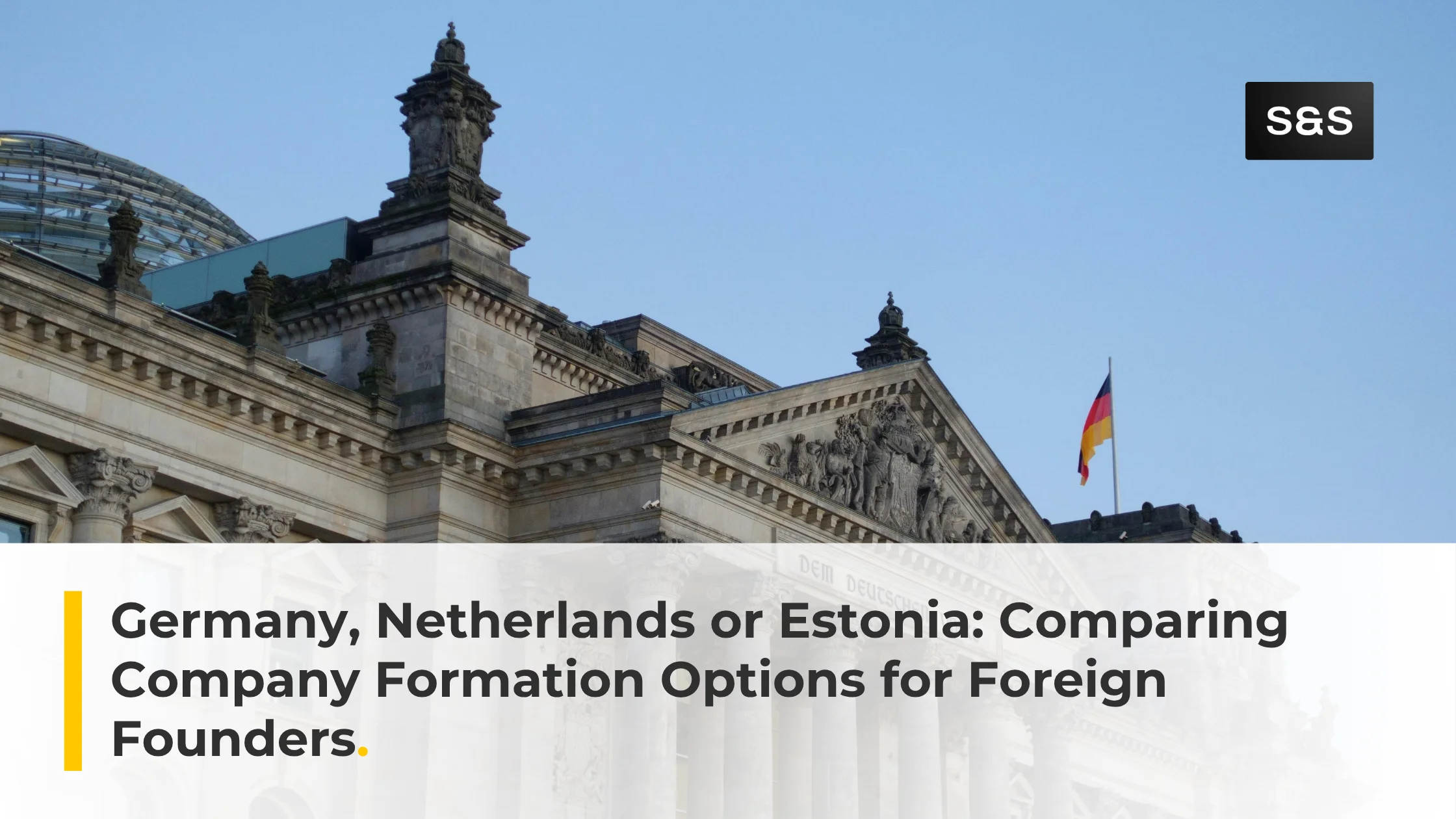
Germany, Netherlands or Estonia: Comparing Company Formation Options for International Founders
A practical comparison of Germany GmbH, Netherlands BV, and Estonia OÜ for foreign founders: capital, tax, formation process, banking, permanent establishment risk, and where each option actually makes sense.
Contentstap to expand
Short answer: Germany, the Netherlands, and Estonia are the three EU jurisdictions most frequently compared by international founders deciding where to incorporate. Germany's GmbH gives direct access to the EU's largest economy and a straightforward path for founders who plan to operate there in person. The Netherlands BV is a well-established vehicle for European holding structures and IP-intensive businesses, with real advantages for the right structure but genuine substance requirements attached. Estonia's e-Residency program enables fast, fully digital company formation and a distinctive tax model, but delivers those advantages only to businesses with genuine Estonian substance. For founders whose actual operations are in Germany, registering elsewhere typically adds a second compliance layer rather than replacing the German one. The right answer depends on where you actually do business, not just on where the paperwork is filed.
Germany: the GmbH in detail
The GmbH (Gesellschaft mit beschränkter Haftung) is Germany's dominant commercial entity. It is the structure German clients, banks, landlords, and authorities expect to deal with, and it is the natural vehicle for anyone building a business that operates primarily in the German market.
Capital. €25,000 minimum share capital, of which €12,500 must be deposited and confirmed by a bank before the Handelsregister entry. The remaining €12,500 is a deferred obligation. The capital is an asset of the company, not a fee, and can be used for operations after formation.
Formation process. Notarisation of the articles of association (Gesellschaftsvertrag or the simplified Musterprotokoll), corporate bank account opening, capital deposit, Handelsregister entry, Transparenzregister beneficial owner registration, tax registration at the Finanzamt, and trade registration at the Gewerbeamt. Total timeline is typically four to eight weeks. Since 2022, certain standard GmbH formations can be completed by video notarisation.
Tax. Körperschaftsteuer (corporate income tax) at 15 percent, a solidarity surcharge of 5.5 percent on the corporate income tax amount, and Gewerbesteuer (trade tax) set by the municipality, typically between 14 and 17 percent in major German cities. Combined effective rate commonly runs at 29 to 31 percent. VAT (Umsatzsteuer) applies at 19 percent standard rate; quarterly prepayments are required in most cases.
Market. Germany has approximately 84 million consumers and is the largest economy in the EU by GDP. It is the primary market for industrial goods, machinery, automotive, chemicals, financial services, and increasingly technology. For foreign companies targeting European B2B clients, a German entity is often a practical requirement for contracts, procurement, and regulatory compliance.
Immigration pathway. Non-EU founders who wish to live in Germany and operate their business there apply for the § 21 AufenthG self-employment residence permit. The permit requires demonstrating economic interest, adequate financing, and relevant qualifications. The initial permit is typically issued for three years.
Weaknesses. Formation is slower than the Netherlands or Estonia. The notary requirement adds time and cost. The €12,500 paid-in capital is a higher cash commitment at incorporation than either comparator. German bureaucracy, particularly around bank account opening for non-resident foreign founders, can add unexpected delays.
Netherlands: the BV in detail
The BV (Besloten Vennootschap) is the Netherlands' private limited company, substantially reformed in 2012 by the Flex BV legislation, which removed the €18,000 minimum capital requirement and simplified governance rules.
Capital. Minimum €0.01 following the 2012 reform. In practice, founders often contribute a nominal amount (€100 to a few thousand euros) to demonstrate some capitalisation and to cover initial costs. There is no requirement to deposit capital before registration.
Formation process. Notarial deed of incorporation, registration with the Kamer van Koophandel (KVK, Chamber of Commerce), and tax registration. English is widely accepted in Dutch legal and commercial settings. Timeline is typically two to four weeks. The Netherlands has a well-developed infrastructure for international incorporations, with numerous specialist law firms and notaries handling foreign founder setups routinely.
Tax. Corporate income tax (Vennootschapsbelasting, VPB) at 19 percent on profits up to €200,000 and 25.8 percent above that. The innovation box (innovatiebox) regime taxes profits derived from self-developed qualifying intellectual property at an effective rate of 9 percent. The participation exemption exempts dividends and capital gains received from qualifying subsidiaries from Dutch corporate tax. The Netherlands has one of the world's most extensive tax treaty networks.
Substance requirements. To access the Netherlands' treaty benefits and avoid being treated as a letterbox company, a Dutch BV must have genuine local substance. Anti-Tax Avoidance Directive (ATAD) rules and Netherlands domestic anti-abuse legislation require that the company's actual management and decision-making take place in the Netherlands, that there are qualified local employees or directors, and that the company has real operational activity or a meaningful holding function. A Dutch entity with a registered address and a non-resident sole director, with no Dutch employees, actual management, or operational activity, will struggle to access treaty benefits and may face reclassification.
Immigration. The Netherlands has a self-employed residence permit (Zelfstandig ondernemer) for non-EU nationals and a startup visa for innovative founders working with an accredited facilitator. Neither is as frequently used for general business immigration as Germany's § 21 AufenthG.
When the Netherlands makes sense. A Dutch BV is a strong choice for companies building a European group structure, holding IP that generates royalties across multiple EU countries, or establishing a regional headquarters where English-language operations, flexible governance, and access to the Amsterdam or Rotterdam ecosystem matter. It is less well suited to founders who primarily want to sell into the German market or who need an entity that German counterparts will recognise as operationally based in Germany.
Estonia: the OÜ and e-Residency in detail
The OÜ (Osaühing) is Estonia's private limited company. Estonia gained significant international attention through its e-Residency program, which allows non-residents to form and manage a company entirely digitally without visiting Estonia.
Capital. The minimum share capital is €2,500, but this can be declared at formation with an obligation to pay it in later rather than being deposited immediately. Many e-Residency companies are formed with a nominal contribution. Estonia has indicated a move toward requiring capital payment, so the current rules should be verified at the time of formation.
E-Residency. The e-Residency card is a digital identity card issued by the Estonian government. It allows the holder to digitally sign documents, authenticate online, and manage an Estonian company remotely. The card costs approximately €100 to 120 and takes three to eight weeks to receive at the collection point (Estonian embassies or police prefectures in selected cities). E-Residency is not a visa. It grants no right to live, work, or be physically present in Estonia or any other EU country. The holder remains subject to the tax law of their country of residence.
Formation. Registration via the Estonian e-Business Register can be completed in days once the e-Residency card is active and the bank account is open. No notary visit is required. This is substantially faster than Germany or the Netherlands.
Tax: how it actually works. Estonia applies 0 percent corporate income tax on profits that are retained and reinvested within the company. When the company distributes profits as dividends, a 20/80 tax applies: the gross distribution is grossed up so that the tax is effectively 20 percent on the pre-tax amount (the calculation is that €80 of net dividend requires paying €20 in tax, making the effective rate 25 percent of the net distributed amount). This model is attractive for businesses that reinvest profits rather than distribute them regularly, because tax is deferred until distribution.
The permanent establishment issue. This is the most important practical limitation of the Estonian OÜ for founders who are not based in Estonia. German tax law, following OECD Model Convention principles, taxes profits attributable to activities that take place in Germany. A permanent establishment (Betriebsstätte) is created when a company has a fixed place of business in Germany, has employees or a dependent agent concluding contracts in Germany, or when the company's effective place of management is in Germany. An Estonian OÜ managed by a sole founder who lives and works in Germany, serves German clients, and holds management meetings in Germany is likely to be treated by the German Finanzamt as having a German permanent establishment, with the result that German corporate tax applies to the profits generated from that establishment. Estonia's 0 percent reinvestment rate does not override German domestic tax law or the Estonia-Germany tax treaty, which allocates taxing rights to Germany for profits attributable to German business activity.
This does not mean all Estonian companies are tax-inefficient for German founders. A genuinely Estonian company, with management decisions made in Tallinn, employees or contractors operating primarily from Estonia, and revenues generated from non-German sources, may legitimately benefit from the Estonian tax structure. But a founder sitting in Munich, managing their business from a home office, with German clients and no genuine Estonian presence, is in a legally complex position that requires specialist advice in both jurisdictions.
Banking for Estonian companies. Opening a bank account is the part of the Estonian formation process that causes the most difficulty. Estonian banks have tightened their compliance requirements significantly for non-resident company accounts. Several founders find that Estonian banks decline non-resident OÜ accounts, and they end up using fintech providers such as Wise Business, Revolut Business, or Airwallex as their banking solution. These providers accept Estonian OÜ accounts but operate under e-money institution licences rather than full banking licences, which can create limitations for certain types of transactions or corporate counterparts.
Three-way comparison
| Germany GmbH | Netherlands BV | Estonia OÜ | |
|---|---|---|---|
| Minimum share capital | €25,000 | €0.01 | €2,500 |
| Capital paid at formation | €12,500 minimum | None | Optional |
| Formation time | 4 to 8 weeks | 2 to 4 weeks | Days (once bank account open) |
| Notary required | Yes | Yes | No |
| Corporate tax on retained profits | 29 to 31% | 19 to 25.8% | 0% |
| Corporate tax on distributed profits | 29 to 31% | 19 to 25.8% | Approx. 20% gross |
| IP/innovation regime | None | Innovation box (9%) | None |
| Participation exemption | Partial (Schachtelprivileg) | Full (domestic + EU) | N/A |
| Immigration pathway to residency | § 21 AufenthG (established) | Self-employed / startup visa | None (e-Residency is not a visa) |
| Language | German (English increasingly accepted) | Dutch / English | Estonian / English |
| German market access | Direct | Requires additional presence | PE risk if managed from Germany |
| Typical use case | German operations, relocation | EU group holding, IP, HQ | Remote / digital-first, no physical base |
Permanent establishment: what it means in practice
The permanent establishment concept is the most commonly misunderstood element in the Estonia and Netherlands discussion. It is worth illustrating concretely.
Scenario A: founder based in Dubai, company registered in Estonia, clients in the US and Southeast Asia. No German connection. Estonia's tax structure applies, and there is no German tax obligation. This is a situation where the Estonian OÜ works as advertised.
Scenario B: founder based in Berlin, company registered in Estonia, clients in Germany and the Netherlands. The founder works from home, holds meetings in Berlin, and the company's decisions are made in Germany. German tax authorities can argue that the effective place of management is Germany, creating a permanent establishment. German corporate tax applies to profits attributable to that establishment. The Estonian OÜ does not provide tax relief in this situation.
Scenario C: Dutch BV holding IP licensed to a German GmbH subsidiary. The Dutch BV has a Dutch director, one part-time Dutch employee, and genuine management decisions made in Amsterdam. The GmbH operates in Germany and pays royalties to the BV. This structure can work if the Dutch substance is genuine. If the Dutch BV has no real management, the interest deduction at the German GmbH may be disallowed under anti-avoidance rules, and the Dutch treaty benefits may be denied.
The consistent principle is that tax advantages follow genuine economic activity, not registration.
VAT considerations across the three
VAT treatment follows EU rules in all three cases and does not differ fundamentally based on where the company is registered. B2B sales within the EU are generally zero-rated for VAT at the point of sale (reverse charge mechanism), with the buyer accounting for VAT in their own country. B2C sales to EU customers trigger the One Stop Shop (OSS) regime once thresholds are exceeded. Each company must register for VAT in its country of registration and may need to register in Germany if it has a taxable presence there. An Estonian OÜ with a German permanent establishment would typically need to VAT-register in Germany as well as Estonia.
Hiring employees in each country
Germany. Hiring even one employee in Germany triggers payroll registration, social insurance contributions (approximately 20 percent employer contribution on top of gross salary), Berufsgenossenschaft (statutory accident insurance) enrolment, and monthly payroll filings. Germany has strong employee protection law, including the Kündigungsschutzgesetz, which makes termination procedurally complex for companies with more than ten employees.
Netherlands. Dutch employment law is also employee-protective, with substantial notice period requirements and severance obligations. Employer social contributions are significant. The Netherlands has a tax facility for incoming highly skilled workers (the "30 percent ruling") that allows a portion of salary to be paid tax-free for up to five years. Since 2024 the benefit is tiered over the period rather than a flat 30 percent throughout; the applicable rates should be verified with a Dutch tax advisor at the time of hire.
Estonia. Estonia's employment law is more flexible than Germany or the Netherlands in some respects, with a simpler termination framework and lower non-wage labour costs. However, for a company with German employees managed from Estonia, German labour law applies to those employees regardless of where the company is registered.
Banking for non-resident founders
Germany. Major banks including Deutsche Bank and Commerzbank serve foreign founders, though onboarding can take four to eight weeks. Digital banks including N26 Business and Qonto offer faster access. Foreign founders from certain regions may encounter enhanced due diligence.
Netherlands. Dutch banks including ING, ABN AMRO, and Rabobank are accessible to BV founders, including non-residents, though compliance procedures have tightened significantly in recent years following AML enforcement actions against Dutch banks. Specialist corporate service providers often facilitate account opening for international founders.
Estonia. As noted above, this is the most challenging part of the Estonian formation. The main Estonian banks, LHV and Coop Pank, have tightened non-resident account policies, and many e-Residency founders use Wise Business, Revolut Business, or similar fintech accounts.
Who typically chooses each jurisdiction
Germany GmbH. Founders relocating to Germany and needing a residence permit vehicle. SMEs targeting German B2B clients for whom a German entity is a commercial requirement. Companies establishing European operations with German staff.
Netherlands BV. Groups with multiple EU subsidiaries needing a holding entity. Technology and pharmaceutical companies with significant IP income seeking the innovation box. Companies where English-language operations and access to Dutch legal infrastructure matter.
Estonia OÜ. Fully remote or digital-first businesses with no geographic base and internationally distributed clients. Software product companies and SaaS businesses where the founders genuinely operate from Estonia or are non-resident without a fixed EU base. Founders who want a fast, low-cost EU entity for invoicing and contracting while they assess their long-term location.
Common misconceptions
"Estonia is a tax haven." Estonia's 0 percent rate applies to genuinely reinvested profits within an Estonian company with real Estonian substance. It is not a mechanism for reducing tax on profits generated by operations in Germany or other EU countries.
"I can avoid German compliance by registering elsewhere." Registering in the Netherlands or Estonia while operating in Germany typically results in compliance obligations in both jurisdictions, not just the foreign one.
"The Netherlands is secretive." Dutch BV structures are transparent, fully compliant with EU reporting directives, and subject to increasing scrutiny. They work well for legitimate group structures and are widely used by global companies for exactly that reason.
"Formation speed equals operational simplicity." Estonia's fast formation process does not translate to fast banking, simple ongoing compliance, or freedom from German obligations for Germany-based founders.
How S&S Consult helps
We assist international founders specifically with German market entry: GmbH formation, § 21 AufenthG visa preparation, business plan structuring, and banking introductions. Our focus is Germany. For the Netherlands, Estonian, or any other non-German element of a multi-jurisdiction structure, qualified advisors in those countries should be consulted separately.
For the full German formation process, see our GmbH formation guide. For cost details, see our German business setup costs guide.
Book a free consultation to discuss your situation.
The figures, requirements, tax rates, and procedures in this article reflect the law and standard practice in the relevant jurisdictions at the time of the last review shown above. Tax law, substance requirements, and anti-avoidance rules change frequently and at different times in each country. For decisions involving multi-jurisdiction structures, taxation, or immigration, obtain specialist legal and tax advice in each relevant country before proceeding.
Frequently asked questions
Is it cheaper to form a company in Estonia than in Germany?
Formation fees in Estonia are lower, and the OÜ has a lower minimum capital requirement. However, if your business operates in Germany, you may create a German permanent establishment and owe German tax regardless of where the company is registered. The apparent cost saving disappears if you need to comply with German tax law anyway.
Can I use an Estonian e-Residency company to do business in Germany?
An Estonian OÜ can enter contracts and hold IP. However, if the company's actual management and operations are in Germany, German tax authorities may classify this as a permanent establishment subject to German corporate tax. E-Residency is a digital identity, not a visa, and does not grant the right to live or operate physically in Germany.
What is the difference between a Dutch BV and a German GmbH?
Both are limited-liability companies. The Dutch BV requires only €0.01 in share capital following the 2012 Flex BV reform and benefits from a favourable innovation box tax regime for IP income. The German GmbH requires €25,000 (€12,500 paid at formation) and is better suited to operations serving Germany's domestic market. The Netherlands is often chosen for European holding structures; Germany for direct operational presence.
Do I need to live in Germany to form a GmbH?
No. Foreign nationals can own and direct a German GmbH without residing in Germany. If you plan to relocate, a separate residence permit under § 21 AufenthG is required.
Is corporate tax higher in Germany than in the Netherlands?
Yes, in most cases. Germany's combined corporate tax, Körperschaftsteuer plus solidarity surcharge plus Gewerbesteuer, typically runs at 29 to 31 percent depending on municipality. The Netherlands applies 19 percent on profits up to €200,000 and 25.8 percent above that, with a 9 percent innovation box rate for qualifying IP income.
Does Estonia really have 0% corporate tax?
Estonia taxes profits at 0% when reinvested in the company and at approximately 20% (on the gross distributed amount) when paid out as dividends. This advantage applies only if the company has genuine substance in Estonia. If your operations are in Germany, German corporate tax applies to those profits regardless of where the company is registered.
Which country is best for a European holding structure?
The Netherlands is widely used for European holding structures, particularly for IP holding and royalty flows, due to its participation exemption, extensive treaty network, and the innovation box. Germany is generally not chosen as a primary holding jurisdiction; its strength is market access and operational headquarters.
Can I convert an Estonian OÜ or Dutch BV to a German GmbH?
Cross-border conversions are possible within the EU under the Mobility Directive, but they involve significant legal and tax complexity in multiple jurisdictions. In practice, most founders incorporate a new GmbH and transfer operations rather than pursuing a formal cross-border merger or conversion.
Does Germany have a startup visa?
Germany does not have a startup visa in the same form as some other EU countries. Non-EU founders typically use the § 21 AufenthG self-employment residence permit, which requires demonstrating economic viability and adequate financing for the planned activity.
Can I run a business in Germany through a foreign company without creating a German company?
In some cases, yes: providing services remotely to German clients from abroad, for example, does not automatically create a German entity obligation. However, having employees in Germany, operating from a fixed place of business in Germany, or having a dependent agent conclude contracts in Germany typically creates a permanent establishment with German tax and registration obligations.