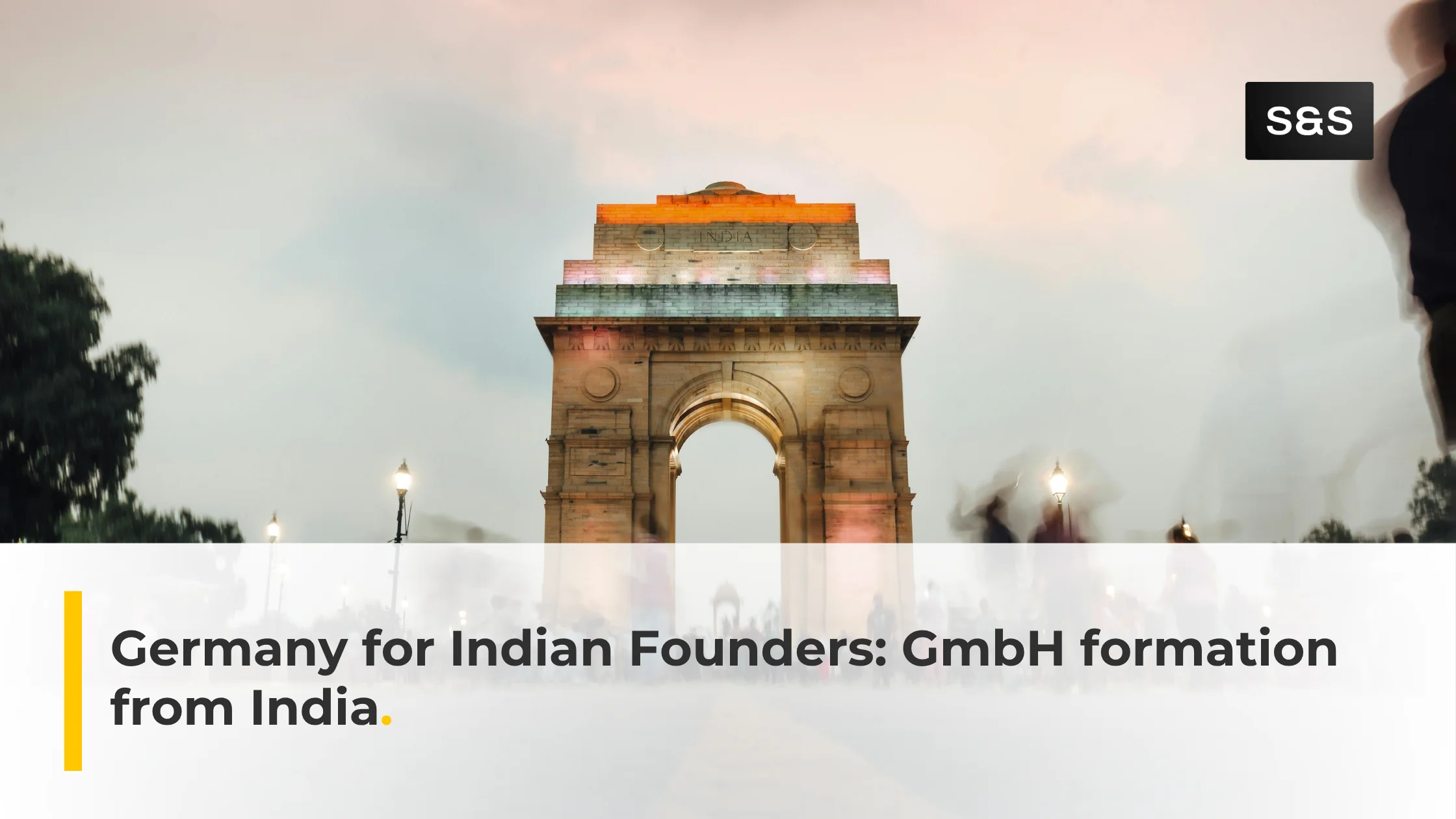
Setting Up a GmbH in Germany: A Guide for Indian Entrepreneurs
How Indian founders and NRIs form a German GmbH: FEMA compliance, ODI reporting, LRS transfers, apostille via MEA, the India-Germany DTAA, banking, the § 21 AufenthG visa, and sector-specific context for IT, pharma, and manufacturing founders.
Contentstap to expand
Short answer: Indian entrepreneurs and NRIs can form a German GmbH under the same legal framework as any non-EU founder. The German formation process, notarisation, capital deposit, and Handelsregister registration, takes four to eight weeks. The India-specific considerations are primarily on the Indian regulatory side: FEMA compliance for outbound investment, AD bank reporting, and the LRS or ODI route for transferring the share capital to Germany. The India-Germany DTAA provides a framework for managing double taxation on dividends and business income. For founders planning to relocate, the § 21 AufenthG permit is available to Indian nationals through German embassies in India.
Why Indian entrepreneurs choose Germany
India and Germany have deep commercial ties across technology, engineering, pharmaceuticals, automotive components, chemicals, and professional services. India is Germany's fastest-growing trade partner in Asia, and the relationship goes well beyond trade: tens of thousands of Indian professionals work in Germany, several major Indian multinationals have established European headquarters there, and a growing wave of Indian startup founders is choosing Germany as their EU entry point.
More specific drivers include:
EU market access. A German GmbH is an EU entity that can contract across all 27 member states. For Indian IT companies, engineering firms, and consulting practices, a German entity is often a commercial requirement for European clients who need a local counterpart for compliance, contract, or procurement reasons.
Sector alignment. The areas of greatest commercial overlap between India and Germany are also among Germany's economic strengths. Indian IT and software companies have strong demand from German automotive, industrial, and financial services clients. Indian pharmaceutical companies are significant generic drug exporters to Germany and the EU. Indian automotive component manufacturers supply German OEMs directly or through their European subsidiaries.
Talent and research. Germany's engineering faculties and research institutions attract a significant number of Indian students each year. Several founders building German companies began as students at German universities and transitioned into entrepreneurship after completing their degrees.
Relocation. Germany's combination of economic opportunity, quality of life, healthcare, and relatively manageable cost of living compared to major US tech cities attracts Indian founders who want to build in Europe long-term.
Key sectors: India and Germany
Information technology and software. This is the most active sector for Indian founders entering Germany. Indian IT services companies have served German automotive, industrial, and financial clients for decades, and a growing number are establishing German subsidiaries to move closer to clients and hire locally. TCS, Infosys, Wipro, and HCL all have substantial German operations. Smaller Indian product and SaaS companies use the GmbH to create a credible EU presence for enterprise sales.
Pharmaceuticals. India is one of the world's largest producers of generic pharmaceuticals, and Germany is a major European market for generic drugs. Several Indian pharma companies have established German distribution arms or acquired German companies to access the European market directly. Regulatory requirements (approval from the Bundesinstitut für Arzneimittel und Medizinprodukte, BfArM) make local presence practically necessary for market participants.
Automotive and mechanical engineering. German OEMs and tier-one suppliers source components globally, and Indian manufacturers in precision engineering, castings, forgings, and electronics have established German entities to manage client relationships and local logistics. The German automotive supply chain requires suppliers to have accountable EU entities for quality management and contract purposes.
Consulting and professional services. Indian management consulting, legal process outsourcing, and financial services firms use German GmbHs to serve European clients from a local base. German B2B clients generally prefer to contract with local entities for services engagements of meaningful size.
FEMA and overseas investment: what Indian founders need to know
The Foreign Exchange Management Act (FEMA) and the Overseas Investment Rules, 2022 (which replaced the previous FEMA notification framework) govern how Indian residents invest in foreign companies. This framework does not prevent German GmbH formation; it requires that the investment be made through the correct regulatory channel and properly reported.
Who is a resident Indian under FEMA. The definition is based on duration and intent of stay. An Indian citizen who has been in India for more than 182 days in the preceding financial year and whose intent is to remain in India is a resident under FEMA. Indian citizens living abroad for work, business, or education are typically non-residents. OCI card holders who are resident outside India are generally treated as non-residents.
The Overseas Direct Investment (ODI) framework. Investment in a foreign company by an Indian resident constitutes ODI. Under the automatic route, an Indian resident individual can invest in an overseas company up to 400 percent of their net worth (as per the latest audited balance sheet or income tax return). This threshold is generous for most founders investing €12,500 to €25,000 in a German GmbH. No prior RBI approval is required for investments within this limit; the transaction is processed through an Authorised Dealer (AD) bank.
The Liberalised Remittance Scheme (LRS). The LRS allows individual Indian residents to remit up to $250,000 per financial year abroad for permissible transactions, including overseas direct investment. For a GmbH share capital deposit of €12,500 (approximately $13,500 at current rates), this is well within a single year's LRS capacity. The remittance is processed through an AD bank by submitting Form A2 with the purpose code for overseas direct investment (A0020 under the current RBI coding). The AD bank completes the regulatory reporting on the remitter's behalf.
Form ODE reporting. All overseas direct investments by Indian residents must be reported to the RBI through the AD bank in the prescribed format. The AD bank handles submission. The founder should retain documentary evidence of the transaction: SWIFT confirmation, bank statement, and the Form A2 submission record. These documents are also useful for German bank onboarding.
NRIs and OCI card holders. Non-resident Indians (NRIs) and OCI holders who are non-residents of India have greater flexibility. They are generally not subject to FEMA investment caps for overseas investments, and their investment in a German GmbH is treated more like a foreign national's investment. NRIs and OCI holders maintaining NRE (Non-Resident External) accounts in India can transfer funds from those accounts abroad freely, as NRE account balances are repatriable.
The apostille process for Indian documents
India joined the Hague Apostille Convention and has been issuing apostilles since 2005. The Ministry of External Affairs (MEA) operates an e-Apostille portal for apostilling Indian-issued public documents for use abroad. The process:
- The document is first attested by the relevant state authority (State Home Department or HRD Ministry, depending on document type) if it is a personal document.
- The MEA apostille is then applied, either at MEA offices in Delhi, Mumbai, Chennai, Kolkata, Hyderabad, and Bengaluru, or through the online e-Apostille portal for certain document types.
- Processing through the e-Apostille portal takes approximately two to five business days for eligible documents; physical submission takes slightly longer.
For German GmbH formation, the documents most likely to need apostilling are powers of attorney if a German-based representative acts for the founder at the notary. Standard identification documents such as passports used for KYC at the German bank do not require apostilling.
Video notarisation. German notaries can conduct standard GmbH formations (Musterprotokoll) via video call since 2022. Indian founders can use this route to complete the notarisation from India without travelling to Germany, eliminating the need for a physical power of attorney and its apostille. Confirm availability with the specific notary in advance.
Banking
German banks open corporate accounts for Indian founders routinely, and there is no systematic issue with Indian-origin accounts in the way there can be for some other jurisdictions. The KYC process follows standard international procedures.
What to prepare. German banks typically request: certified passport copy, proof of residential address in India (utility bill, bank statement, or Aadhaar card showing address), source of funds documentation for the share capital (Indian bank statements showing available funds and their origin), a description of the GmbH's planned business activities, and the corporate formation documents once the notarisation is complete.
Banks with India connections. Deutsche Bank has an established India operations centre and is among the more India-familiar German banks. Commerzbank and HSBC Germany also have international client experience. For founders who have existing relationships with Indian banks that have German correspondent banking relationships, that connection can sometimes facilitate introductions.
Digital banks. N26 Business, Qonto, and Penta are accessible options with faster onboarding. They are a practical starting point for founders who need an account opened within the formation timeline.
Timeline. Plan four to eight weeks for traditional German bank account opening. Because the capital deposit is needed before the Handelsregister entry, starting the banking process in parallel with or before the notarisation reduces the overall formation timeline.
Transferring capital from India. International wire transfers from Indian banks (HDFC Bank, ICICI Bank, SBI, Axis Bank, and others all have international banking divisions) to German bank accounts are processed routinely. The AD bank will require the Form A2 with the LRS or ODI purpose code and will submit the RBI reporting. SWIFT transfers from India to Germany typically clear in two to four business days. First-time large international transfers occasionally trigger additional bank compliance review in India; allowing an extra week for this is prudent.
The India-Germany Double Taxation Avoidance Agreement
India and Germany have had a DTAA in force since 1996. A Protocol updating certain provisions was signed in 2020 and entered into force in 2023. The agreement covers:
Business profits (Article 7). Profits of an Indian enterprise are taxable in Germany only if the enterprise has a permanent establishment there. If an Indian company has a German subsidiary (the GmbH), the German subsidiary's profits are taxed in Germany; dividends paid to the Indian parent are then the point at which the treaty's dividend article applies.
Dividends (Article 10). Dividends paid by a German GmbH to an Indian shareholder are taxable in Germany (withholding tax) at a rate not exceeding 10 percent where the Indian shareholder is a company holding at least 10 percent of the German company's capital, and 10 percent in other cases. In practice, Germany applies withholding tax (Kapitalertragsteuer) at 25 percent plus solidarity surcharge as a gross withholding, and the shareholder can apply for a refund down to the treaty rate. The treaty rate is more favourable for Indian corporate shareholders than for individual shareholders who do not hold through a company.
Interest (Article 11). Interest paid from Germany to India is taxable in Germany at a maximum of 10 percent under the treaty.
Royalties and fees for technical services (Article 12/13). Royalties and technical service fees paid from Germany to India are taxable in Germany at rates the treaty specifies, and credited against Indian tax. This is relevant for Indian founders who license IP or provide technical services from India to their German GmbH.
Credit mechanism. The treaty uses a credit method: tax paid in Germany is credited against the Indian tax liability on the same income. India does not exempt the German income from Indian tax but provides a credit for German tax paid.
Social security
India and Germany have a social security agreement in force since November 2009. It covers pension (old-age) insurance. Indian nationals sent to Germany by an Indian employer to work on a temporary assignment (typically up to five years) can remain under the Indian Employees' Provident Fund and Pension Scheme rather than contributing to the German statutory pension system. This exemption is documented by a Certificate of Coverage issued by the EPFO in India.
For Indian entrepreneurs who relocate to Germany and become self-employed or managing directors of their own GmbH, the German social insurance system typically applies. Germany's social insurance framework covers statutory pension, health insurance, care insurance, and, for eligible employees, unemployment insurance. Managing directors who own a controlling stake in their GmbH are sometimes exempt from mandatory pension and unemployment insurance; the specific position depends on ownership structure and the exact employment relationship.
The IGCC and support infrastructure
The Indo-German Chamber of Commerce (IGCC), also known as AHK India, operates offices in Mumbai, Delhi, Chennai, Pune, and Bengaluru, and has a corresponding presence in Germany through the Deutsch-Indische Handelskammer (AHK Indien) in Düsseldorf. The chamber provides market entry support, business plan assessments, legal referrals, and networking for Indian companies looking to expand to Germany and vice versa. For founders preparing a § 21 AufenthG application, a positive IHK assessment of the business plan is often part of the process, and the IGCC network can be valuable in understanding what German authorities expect.
The § 21 AufenthG visa for Indian founders
Indian nationals require a visa to enter Germany. For short visits of up to 90 days in a 180-day period, a Schengen visa is applicable. For long-term relocation to operate a business, the § 21 AufenthG self-employment residence permit is the standard pathway.
Applications are made at German embassies in India. Missions are located in New Delhi (embassy), Mumbai, Chennai, Kolkata, and Bengaluru (all consulates). Embassy appointment availability can vary significantly by mission and season; scheduling the appointment well in advance of the planned move is important.
Requirements. The authority assesses the business plan for economic interest (whether the planned activity is in demand in Germany and expected to have positive economic effects), the adequacy of financing (whether the business and the founder's personal living costs can be covered), and the founder's qualifications and professional background. For Indian founders in technology, engineering, and management consulting, the combination of strong professional credentials, a credible German market for the service or product, and a well-capitalised GmbH typically makes for a convincing application.
German language. The § 21 AufenthG does not have a minimum German language requirement, unlike some other German residence pathways. Many Indian founders in technology and professional services operate in English and build German language capability over time after arrival. Demonstrating some German language effort (A1 or A2 level) can strengthen an application but is not formally required.
Processing time. Between applying for the embassy appointment, the permit processing itself, and any IHK assessment timeline, founders should allow four to eight months from starting the process to having the permit in hand. Running the GmbH formation in parallel means the company can be established and operational before the founder arrives.
German cities for Indian entrepreneurs and families
Frankfurt and the Rhine-Main region have a large Indian community, strong connections to Indian banks and businesses, and direct flight connections to Mumbai, Delhi, and Bengaluru. Frankfurt's financial sector has substantial demand for Indian IT and consulting services, and the city's international infrastructure makes it a practical base.
Munich has the highest concentration of automotive, industrial, and engineering sector headquarters in Germany. For Indian companies serving those sectors, Munich provides proximity to decision-makers. The Indian community in Munich is well established and growing, and the city has good direct flight connections to Indian metros.
Berlin attracts a growing number of Indian founders in technology, media, and creative industries. The startup ecosystem is internationally oriented and English-friendly, and housing costs, while rising, remain lower than Munich or Frankfurt.
Stuttgart and the surrounding Baden-Württemberg region are important for automotive and mechanical engineering. Several Indian automotive component suppliers have established German operations in and around Stuttgart given the proximity to Mercedes-Benz, Porsche, and Bosch headquarters.
Düsseldorf has strong IT sector activity and is the hub for many Asia-headquartered companies in Germany. The IGCC/AHK Indien offices are based there, and the city has an international community including a significant Indian professional population.
Common mistakes Indian founders make
Not engaging the AD bank before the transfer. The FEMA reporting requirement and Form A2 submission should be completed before the wire transfer from India to Germany. Retroactive compliance is possible but more complex.
Underestimating the bank account timeline in Germany. The capital deposit must happen before the Handelsregister entry. Founders who complete the notarisation before the German bank account is open will be waiting. Start the German banking process before or simultaneously with the notarisation.
Treating the DTAA as eliminating German tax. The DTAA allocates taxing rights and provides credit mechanisms; it does not typically eliminate German tax. German corporate tax on GmbH profits applies regardless of the founder's tax residency.
Starting the § 21 AufenthG process too late. Indian founders sometimes plan to arrive in Germany within weeks of deciding to relocate, only to find that embassy appointments are available two to three months out and the permit processing adds several months beyond that. The process should begin as early as possible.
How S&S Consult helps
We support Indian founders on the German side of the market entry process: entity formation, notary coordination, apostille process guidance, business plan preparation for the § 21 AufenthG application, and banking introductions. FEMA compliance, LRS reporting, and Indian-side tax structuring require a qualified Indian CA or legal advisor familiar with overseas investment rules; that advice sits outside our scope. On the German side we handle the coordination and can connect founders with a qualified Steuerberater.
For the full formation process, see our GmbH formation guide. For cost details, see our German business setup costs guide.
Book a free consultation to discuss your India-to-Germany setup.
The figures, requirements, and procedures in this article reflect German law, FEMA provisions, and standard market practice at the time of the last review shown above. FEMA rules, RBI circulars, DTAA provisions, and German tax regulations change. This article is for informational purposes only. For decisions involving overseas investment compliance, double taxation, or German residence permits, engage qualified advisors in both India and Germany.
Frequently asked questions
Can Indian citizens form a GmbH in Germany?
Yes. Indian citizens can own and direct a German GmbH without living in Germany. There is no restriction on foreign ownership of a German company. The formation process is the same as for any non-EU founder: notarisation, capital deposit, and Handelsregister registration.
Does FEMA apply when an Indian resident invests in a German GmbH?
Yes. Indian residents investing in foreign companies are governed by FEMA and the Overseas Investment Rules, 2022. Equity investment in a foreign company qualifies as Overseas Direct Investment (ODI). Under the automatic route, an Indian resident individual can invest up to 400 percent of their net worth, subject to AD bank reporting. The LRS allows individuals to remit up to $250,000 per financial year for permissible capital account transactions.
Do OCI card holders face the same FEMA restrictions?
OCI card holders who are non-residents of India are generally not subject to FEMA in the same way as Indian residents. OCI holders resident abroad are treated similarly to foreign nationals for overseas investment purposes. However, OCI holders who are ordinarily resident in India fall under FEMA. Specific situations should be verified with an authorised dealer bank or FEMA-specialised advisor.
What documents do Indian founders need for GmbH formation?
Passport, proof of residential address (utility bill, bank statement, or Aadhaar showing current address), and source of funds documentation for the share capital. Documents may require certified translation into German or English. Indian documents used in legal proceedings in Germany need an apostille, obtainable through the MEA e-Apostille portal or state-level authorities.
Is there a double taxation agreement between India and Germany?
Yes. India and Germany have a bilateral DTAA in force since 1996, updated by a 2020 Protocol. It allocates taxing rights over business profits, dividends, interest, and royalties, and provides relief from double taxation through credit or exemption mechanisms. The applicable provisions depend on the specific income type and the resident status of the parties involved.
Will German banks open accounts for Indian founders?
Yes. German banks open corporate accounts for Indian founders, though the process involves standard KYC procedures and may take four to eight weeks at a traditional institution. Indian founders should prepare source of funds documentation, a business description, and proof of address. Internationally oriented banks and digital banks tend to offer more accessible onboarding.
Can an Indian national get the § 21 AufenthG residence permit for self-employment?
Yes. Indian nationals apply for the § 21 AufenthG permit at a German embassy in India. Requirements include a viable business plan, evidence of adequate financing, and relevant qualifications. German embassies in India are located in New Delhi, Mumbai, Chennai, Kolkata, and Bengaluru.
Can I transfer funds from India to Germany to fund the GmbH share capital?
Yes. Under the LRS, individuals can remit up to $250,000 per financial year for permitted capital account transactions including overseas direct investment. Transfers use Form A2 submitted to the AD bank. For amounts beyond the LRS cap, the FEMA ODI automatic route applies with AD bank reporting.
What is the India-Germany Social Security Agreement?
India and Germany have a social security agreement in force since 2009. It covers pension insurance and aims to prevent double contribution. Indian nationals sent to Germany for work by an Indian employer can remain under the Indian social security system for up to five years. Self-employed founders in Germany generally fall under the German social insurance framework.