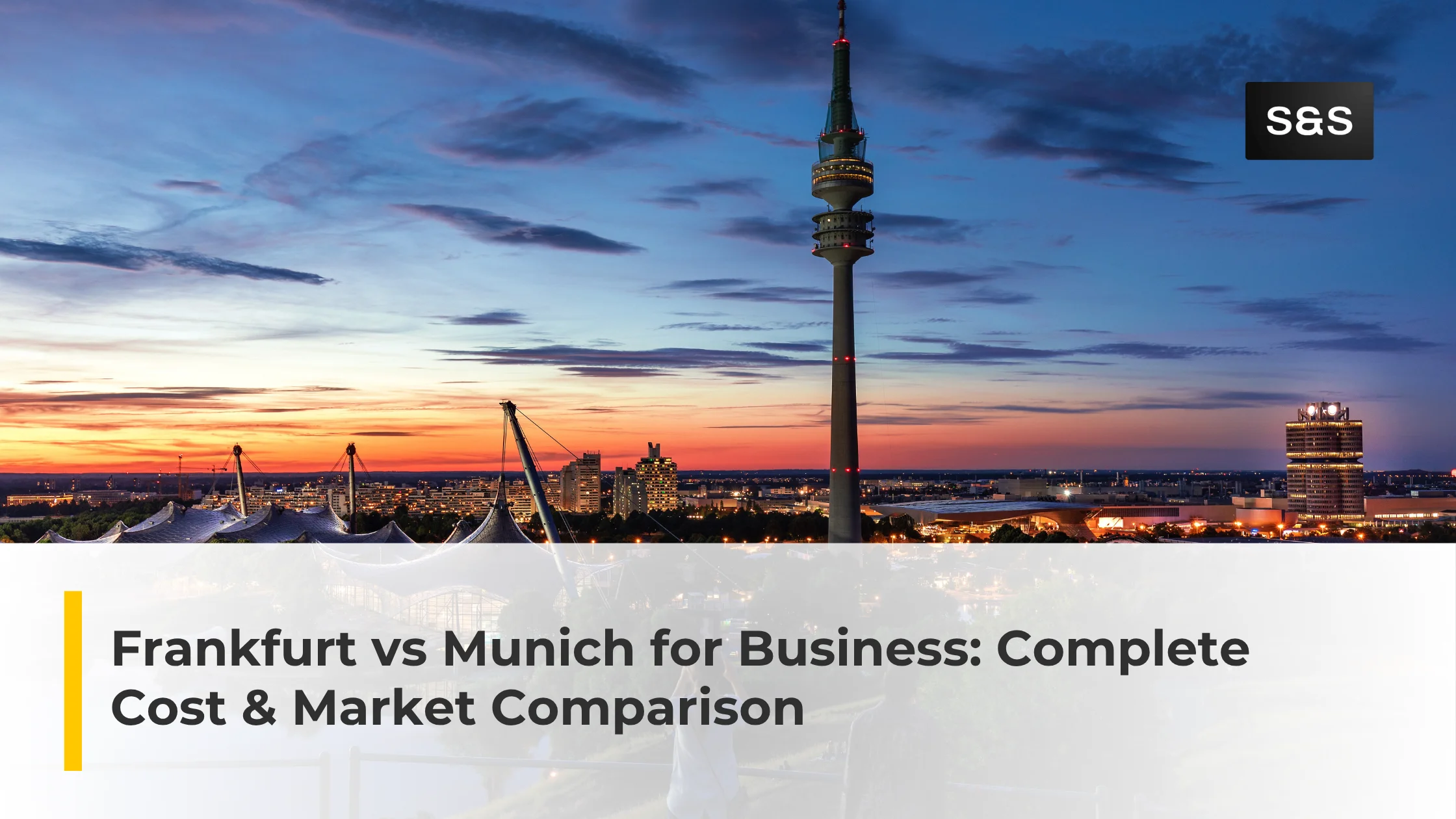
Frankfurt vs Munich for Business: A Foreign Founder's Comparison
Frankfurt or Munich for your German business? Comparing industries, taxes, costs, talent, and the foreign founder's decision factors across both cities.
Contentstap to expand
Short answer: Frankfurt and Munich are Germany's two most international and most cost-intensive business locations, but they suit different industries. Frankfurt is the clearer choice for finance, banking, fintech, insurance, logistics, and businesses needing FRA airport's global connectivity or proximity to the ECB and Deutsche Börse. Munich is the clearer choice for tech, automotive, industrial technology, aerospace, life sciences, and businesses targeting the deep-tech and corporate-headquarters ecosystem (BMW, Siemens, Allianz, Munich Re, Infineon). Munich is more expensive across most cost categories and has a moderately higher Gewerbesteuer rate. Frankfurt has the stronger international airport. Both cities have foreign-born populations around 30% and operate substantially in English in their relevant business segments. This guide compares both across the dimensions that matter for a foreign-founder location decision.
The headline differences at a glance
| Dimension | Frankfurt | Munich |
|---|---|---|
| Population (city / metro) | ~770k / ~5.6M (Rhine-Main) | ~1.5M / ~3M |
| Lead industries | Finance, banking, insurance, logistics, pharma | Tech, automotive, industrial, aerospace, life sciences |
| Major anchors | ECB, Deutsche Börse, Deutsche Bank, Commerzbank, KfW, ING | BMW, Siemens, Allianz, Munich Re, Linde, Infineon, MTU |
| Gewerbesteuer Hebesatz | ~460% | ~490% |
| Combined effective corporate tax rate | ~31.93% | ~32.98% |
| Prime office rent (per m²/month) | €40-55 (banking district) | €30-50 (Altstadt, Bogenhausen) |
| Average tech salary | High (national-average finance premium for finance roles) | Among Germany's highest |
| International airport | FRA (Germany's largest, Europe's #3) | MUC (Germany's #2, strong continental + global) |
| Startup ecosystem | Strong in fintech; smaller in tech generally | Largest in Germany; UnternehmerTUM, deep-tech leader |
| Quality of life ranking | High, sometimes lower than Munich | Consistently among Europe's top |
| Foreign-born population | ~30% | ~30% |
| English-friendliness | Very high (banking sector) | Very high (tech sector) |
| Lufthansa hub | Yes (primary German hub) | Yes (secondary German hub) |
When Frankfurt is the right choice
Frankfurt is the strategic answer for several industry profiles where Munich does not compete on equal terms.
Finance, banking, and fintech
Frankfurt is Germany's financial capital and one of the EU's principal financial centres alongside Paris, Amsterdam, and Dublin. The European Central Bank (ECB) headquarters, the Deutsche Bundesbank's main offices, Deutsche Börse, and the headquarters of Deutsche Bank, Commerzbank, KfW, ING-DiBa, and DZ Bank are all in Frankfurt. Major international banks (JPMorgan, Goldman Sachs, BNP Paribas, Citi, UBS, Morgan Stanley) have substantial Frankfurt offices, in several cases moved here from London post-Brexit.
For finance, banking, fintech, asset management, and insurance-tech businesses, Frankfurt offers:
- Customer proximity (the buyers are in the city).
- Regulatory proximity (BaFin's Frankfurt office, ECB consultation context).
- Talent pool (finance professionals concentrate in Frankfurt).
- Financial press and conferences (Frankfurt is the host city for most German finance events).
- Direct corporate-development access to German finance HQs.
For a foreign founder building in finance or fintech, Frankfurt is rarely the wrong choice. Munich's finance presence (Allianz, Munich Re, HypoVereinsbank) is significant but smaller in finance-specialist depth.
Global logistics and trade
Frankfurt Airport (FRA) is Germany's largest by passenger and Europe's largest by cargo. Lufthansa's primary hub. The airport's logistics belt creates dense logistics, freight-forwarding, and supply-chain businesses around it. The Rhine-Main region's central German location and motorway connectivity also support distribution and logistics businesses serving German and pan-EU customers.
Pharmaceutical and chemical industry-adjacent
Frankfurt is not itself a pharma headquarters city, but the broader Rhine-Main region hosts Merck KGaA (Darmstadt), Sanofi (Frankfurt-Hoechst), Höchst Industrial Park, BASF (Ludwigshafen, downstream), and a substantial chemical-and-pharmaceutical supplier ecosystem. For businesses serving these customers, Frankfurt is the obvious base.
International travel-heavy businesses
Businesses with frequent intercontinental travel benefit materially from FRA's connectivity. Founders flying weekly to North America, Asia, and the Middle East find FRA's direct-flight depth saves materially more time than the Munich-MUC equivalent.
When Munich is the right choice
Munich is the strategic answer for tech, industrial, and corporate-customer businesses where Frankfurt does not compete on equal terms.
Tech and deep-tech
Munich's tech ecosystem is Germany's deepest. TUM (Technical University of Munich) and LMU (Ludwig Maximilian University) jointly produce around 100,000 students. UnternehmerTUM is by several measures Europe's largest startup centre, running pre-seed support, multiple accelerators, the MakerSpace deep-tech hardware development infrastructure, and a venture-capital arm.
Founded-in-Munich anchor companies include Personio (HR software), Celonis (process mining), Flixbus (intercity transport), Lilium (eVTOL aviation), NavVis (3D mapping), Konux (industrial IoT), Quantum-Systems (defence drones), Helsing (defence AI), and Isar Aerospace (small-launch rockets). The cluster effect produces talent, network, and corporate-customer access that Frankfurt does not offer at the same depth in tech.
Automotive and industrial technology
BMW headquarters and main plant, Audi nearby in Ingolstadt, Bosch in nearby Reutlingen, MAN Truck & Bus in Munich. The Bavarian automotive ecosystem is the largest in Germany. For automotive supply, software, OEM-adjacent businesses, Munich is the natural base.
Aerospace
Airbus Defence and Space in Munich, MTU Aero Engines headquartered in Munich, IABG and several other aerospace and aerospace-adjacent companies. Munich is Germany's aerospace centre alongside Hamburg.
Life sciences and biotech
The Martinsried campus west of Munich hosts LMU's biotech-and-medical campus and several biotech companies in the Innovations- und Gründerzentrum Biotechnologie (IZB). For biotech and medical-device businesses, Munich's life-sciences cluster is one of Germany's three strongest (alongside Heidelberg and Mainz).
Insurance
Allianz headquarters, Munich Re headquarters, HypoVereinsbank operations. The insurance industry's concentration in Munich is comparable to Frankfurt's banking concentration. Insurance-tech, reinsurance, and insurance-software businesses benefit from Munich proximity.
Cost comparison: where Munich is more expensive
Office rent. Both cities are at the top of the German market. Munich's central districts typically run €30-50/m² at the prime end; Frankfurt's banking district at the absolute top end (skyscrapers near the ECB) can exceed Munich at €40-55/m². For non-prime locations, Munich is typically more expensive overall.
Salaries. Munich salaries lead Germany for most non-finance roles. Software engineering, AI, deep-tech specialist roles command 10-25% premiums over Berlin or national averages. Frankfurt finance roles command premiums in finance-specialist categories but are closer to Berlin for general tech and operations roles.
Cost of living. Munich is consistently Germany's most expensive city. Housing in particular: Munich rental yields exceed Frankfurt by 15-25% on comparable apartments. Groceries, services, and entertainment also trend higher in Munich.
Corporate tax (Gewerbesteuer). Munich's ~490% Hebesatz yields a combined effective corporate tax rate of approximately 32.98%. Frankfurt's ~460% Hebesatz yields approximately 31.93%. For a business generating €1 million of taxable profit, the absolute tax difference is about €10,500 per year. Meaningful but rarely a deciding factor against the salary and rent differences. See our German corporate tax guide for the calculation framework.
Setup costs. Notary, court, and Steuerberater costs are similar in both cities. Gewerbeanmeldung fee: Munich ~€50, Frankfurt ~€30.
Cost comparison: where Frankfurt has the edge
Hotel and short-stay accommodation. Frankfurt's hotel market is dominated by business travel; supply is high; rates outside trade-fair weeks are often competitive. Munich's hotel market is tighter, particularly during Oktoberfest and major trade-fair seasons.
Office in surrounding areas. Frankfurt's surrounding Rhine-Main region (Eschborn, Offenbach, Bad Homburg, Mainz-Wiesbaden via the Hessen border) offers strong infrastructure at materially lower rents than Frankfurt centre. Munich's surrounding municipalities offer the same pattern but at higher absolute levels.
Logistics costs. Frankfurt's central German location and FRA cargo dominance make it the natural choice for businesses with German or pan-EU distribution operations.
Quality of life and family considerations
Quality of life rankings. Munich consistently ranks among Europe's top cities (Mercer, Monocle, EIU). Frankfurt typically ranks high but below Munich. Drivers of the gap: Munich's proximity to the Alps for outdoor recreation, Bavarian cultural amenities, lower crime rates, and traditionally higher cleanliness and safety scores. Frankfurt's profile is more international-business than residential-quality-of-life.
Housing. Both markets are tight. Munich's is the tightest in Germany; Frankfurt's housing situation is materially easier than Munich's though still expensive by national standards.
International schools. Munich has Munich International School (MIS), Bavarian International School (BIS), Lycée Jean Renoir, and several language-specific schools. Frankfurt has Frankfurt International School (FIS), the European School Frankfurt, Internationale Schule Frankfurt-Rhein-Main, and the Anglophone school network. Both cities have strong international-school capacity; Frankfurt's options sometimes have shorter waitlists.
Cultural amenities. Munich's traditional Bavarian culture (Oktoberfest, beer gardens, Alpine outdoor activities), strong museums, and large parks (Englischer Garten) appeal to many families. Frankfurt's cultural scene is more cosmopolitan and finance-adjacent, with strong opera, museums on the Museumsufer, and a denser nightlife. Both work for international families with different preferences.
Networking and ecosystem differences
Munich ecosystem. UnternehmerTUM, BayStartUp, WERK1, Plug and Play Munich, BMW Startup Garage, Siemens Startup Programs, several active VCs (UnternehmerTUM Funding, 42cap, Project A Munich, Speedinvest Munich). Sector-specific networks: Bayern Innovativ, BioM, Bavarian AI Network, Cluster Mechatronik & Automation. Trade-fair density via Messe München (BAU, ISPO, IFAT, bauma, Automatica).
Frankfurt ecosystem. Frankfurt School of Finance & Management runs finance-focused programmes. TechQuartier and several finance-tech accelerators. Hesse-based VCs (HV Capital nearby, smaller pure-Frankfurt funds). Sector-specific networks: TechQuartier, Hessen Trade & Invest, Finanzplatz Frankfurt Main Finance. Trade-fair density via Messe Frankfurt (IAA Mobility split now, Automechanika, Light + Building, Frankfurt Book Fair).
For tech and deep-tech generalist founders, Munich has the materially larger ecosystem. For fintech and finance-focused founders, Frankfurt has the relevant ecosystem.
A decision framework
Five tests that typically resolve the Frankfurt-vs-Munich choice:
Test 1: Where are your customers? Finance customers → Frankfurt. Automotive/industrial customers → Munich. Pharma/chemical → Frankfurt-adjacent. Tech corporate-customers → mixed, often Munich.
Test 2: Where is your talent pool? Finance specialists → Frankfurt. Software engineers and AI talent → Munich. Aerospace and automotive engineers → Munich.
Test 3: What does your team value culturally? Munich's Alpine proximity and traditional Bavarian quality of life vs Frankfurt's international urban density. Both are valid; ask the team.
Test 4: How much does the airport matter? Weekly global travel → Frankfurt. Mostly continental travel → Munich works fine.
Test 5: What's your cost sensitivity? Munich is more expensive across most categories. Frankfurt outer regions (Eschborn, Bad Homburg, Mainz) offer better cost compromise than Munich outer regions.
The honest truth: most foreign founders should be evaluating Frankfurt-vs-Munich as one of several options, not as a binary. Berlin offers a larger startup ecosystem at lower cost. Düsseldorf and Cologne offer NRW's larger market. Stuttgart sits closer to Mittelstand automotive suppliers. See our German states business guide for the broader picture.
The unexpected middle path: Rhine-Main vs Bavaria broader region
A consideration foreign founders often miss: the Rhine-Main metropolitan region (Frankfurt, Mainz, Wiesbaden, Darmstadt, Offenbach) extends Frankfurt's effective business base across multiple Bundesländer. Similarly, Bavaria's broader region around Munich (Augsburg, Ingolstadt, Regensburg, Nuremberg) creates a wider business base. For some sectors, the metropolitan region matters more than the city itself.
A pharmaceutical-focused business might base in Darmstadt (Hessen, Merck KGaA HQ) rather than Frankfurt itself, with most of the Frankfurt benefits and lower rent. An automotive-software business might base in Ingolstadt (Bayern, Audi HQ) rather than Munich, similarly capturing ecosystem proximity at lower cost.
Common foreign-founder mistakes in the Frankfurt-Munich choice
Choosing one city before defining the sector. The biggest mistake. The right city follows from the sector, not the other way around.
Optimising on tax savings. The 1-percentage-point Gewerbesteuer difference rarely outweighs the other cost and ecosystem factors. Pick the right city for the business, not the slightly lower tax rate.
Ignoring the housing reality. Munich's housing market materially affects hiring. Frankfurt's situation is meaningfully easier but still expensive.
Treating the two cities as interchangeable. They aren't. Frankfurt is finance-and-logistics; Munich is tech-and-industrial. The talent pools, ecosystems, networks, and corporate customers differ structurally.
Overlooking Berlin and other German cities. Foreign founders sometimes default to "Frankfurt or Munich" because they've heard of both, when Berlin or NRW would actually fit their profile better.
How S&S Consult helps
We support international founders evaluating location decisions in Germany, including the Frankfurt-vs-Munich choice, with sector-fit analysis, cost modelling, ecosystem and network introductions, and connections to qualified local advisors (Steuerberater, Fachanwälte, Versicherungsmakler, real-estate agents) in either market. We do not provide tax, legal, or real-estate advice ourselves.
For further context see our setting up in Munich guide for the deeper Munich-specific picture, our German states business guide for the broader 16-Bundesländer comparison, our German corporate tax guide for the Gewerbesteuer detail, and our setup-costs guide for incorporation costs.
Book a free consultation to discuss your situation.
Rents, Hebesätze, ecosystem company examples, and quality-of-life rankings in this article reflect the Frankfurt and Munich markets at the time of the last review shown above. Property markets shift continuously; municipal rates are updated periodically; specific company positions change. This article is general market-entry guidance, not legal, tax, real-estate, or financial advice. For decisions involving location selection, leasing, taxation, or visa applications, please consult qualified local advisors and the relevant German authorities.
Frequently asked questions
Frankfurt or Munich: which is better for foreign businesses?
Different answers for different industries. Frankfurt is the clearer choice for finance, banking, fintech, and businesses that need proximity to the ECB, Deutsche Börse, and the FRA airport's global connectivity. Munich is the clearer choice for tech, automotive, industrial, aerospace, life sciences, and businesses targeting the deep-tech and corporate-headquarters ecosystem (BMW, Siemens, Allianz, Munich Re). For mixed-industry or generalist businesses, Munich has a deeper talent pool and broader sector mix; Frankfurt offers cheaper office space at the prime end and stronger international logistics.
What is the corporate tax difference between Frankfurt and Munich?
Munich's Gewerbesteuer Hebesatz of approximately 490% gives a combined effective corporate tax rate of around 32.98%. Frankfurt's Hebesatz of approximately 460% gives a combined effective rate of around 31.93%. The gap of roughly 1 percentage point on profits favours Frankfurt, but it is rarely the deciding factor for location: salary, ecosystem, and customer access typically dominate the tax difference.
Which city has cheaper office space, Frankfurt or Munich?
Both are among Germany's most expensive office markets, but Munich is typically more expensive at the prime end. Prime grade-A office space in central Munich (Altstadt, Bogenhausen) commonly runs €30-50 per square metre per month; prime Frankfurt office space in the banking district runs €40-55 per square metre per month, often the most expensive in Germany at the very top end (skyscrapers near the ECB). Outer districts of both cities offer materially lower rents (€15-25/m² in outer-Munich municipalities, €18-28/m² in Frankfurt's surrounding areas).
Which city is more international, Frankfurt or Munich?
Both rank among Germany's most international cities, with foreign-born populations around 30%. Frankfurt has the higher per-capita international presence by some measures, driven by the ECB and global banking community. Munich's international community is concentrated in tech, automotive, and corporate-HQ segments, with stronger English-language coverage in the startup ecosystem. For pure business-English coverage, both cities work; for cultural diversity and international community density, Frankfurt typically leads.
Where is the talent pool stronger, Frankfurt or Munich?
It depends on the talent type. Munich has Germany's deepest tech, engineering, and deep-tech talent pool, anchored by TUM and LMU (combined around 100,000 students) plus UnternehmerTUM's startup ecosystem. Frankfurt has the deepest finance, banking, and quantitative-finance talent pool, anchored by Goethe University, the Frankfurt School of Finance & Management, and the European Central Bank presence. For software engineering generalists, Munich's pool is larger. For finance specialists, Frankfurt's pool is unmatched in Germany.
Which industries are strongest in Frankfurt vs Munich?
Frankfurt: finance, banking, fintech, asset management, insurance, professional services, logistics (via FRA airport hub), pharmaceuticals (Merck KGaA in nearby Darmstadt, Sanofi). Munich: automotive (BMW HQ), industrial technology (Siemens HQ), insurance (Allianz HQ, Munich Re HQ), aerospace (MTU, Airbus), semiconductors (Infineon), AI and deep-tech, life sciences (Martinsried biotech cluster). For a foreign founder, the right choice is typically the city that hosts the customer base for your sector.
How does the quality of life compare between Frankfurt and Munich?
Munich consistently ranks higher on European quality-of-life surveys (Mercer, Monocle, EIU) than Frankfurt. Factors favouring Munich: proximity to the Alps for outdoor recreation, Bavarian cultural amenities, lower crime rate, traditionally rated cleaner and safer. Factors favouring Frankfurt: lower housing costs (still high but below Munich), more diverse food scene reflecting the international community, often easier and faster international travel via FRA airport. The cost-of-living difference is meaningful; Munich is more expensive across most categories.
Which city has the better international airport?
Frankfurt Airport (FRA) is Germany's largest and Europe's third-busiest airport by passenger volume and the largest by cargo throughput. It offers direct connections to virtually every major global destination and is the European hub for Lufthansa. Munich Airport (MUC) is Germany's second-busiest, with strong continental connectivity and most major intercontinental destinations, but less depth of direct global routes than Frankfurt. For businesses with frequent global travel, Frankfurt's airport advantage is material; for businesses focused on European customers, both cities work.
What's the startup ecosystem difference between Frankfurt and Munich?
Munich has the materially larger startup ecosystem. UnternehmerTUM is one of Europe's largest startup centres; the Munich VC scene is dense; founded-in-Munich anchor companies include Personio, Celonis, Flixbus, Lilium, NavVis, Helsing. Frankfurt's startup ecosystem is smaller but strong in fintech and finance-tech specifically (with Frankfurt School of Finance, fintech accelerators, and proximity to financial corporates). For tech-and-deep-tech generalist founders, Munich wins; for fintech and finance-focused founders, Frankfurt is more relevant.
Should a foreign founder choose Frankfurt, Munich, or somewhere else entirely?
For tech, deep-tech, automotive, industrial, aerospace, life sciences: Munich. For finance, banking, fintech, insurance, global logistics: Frankfurt. For startup ecosystem and English-friendliness combined with lower cost: Berlin is often a better third option than either Frankfurt or Munich. For diverse industry exposure with the largest German economy: NRW (Düsseldorf, Cologne). For Mittelstand-supplier or industrial-engineering proximity: Baden-Württemberg (Stuttgart). The Frankfurt-vs-Munich decision is the right one only when the foreign founder has already filtered to those two.